

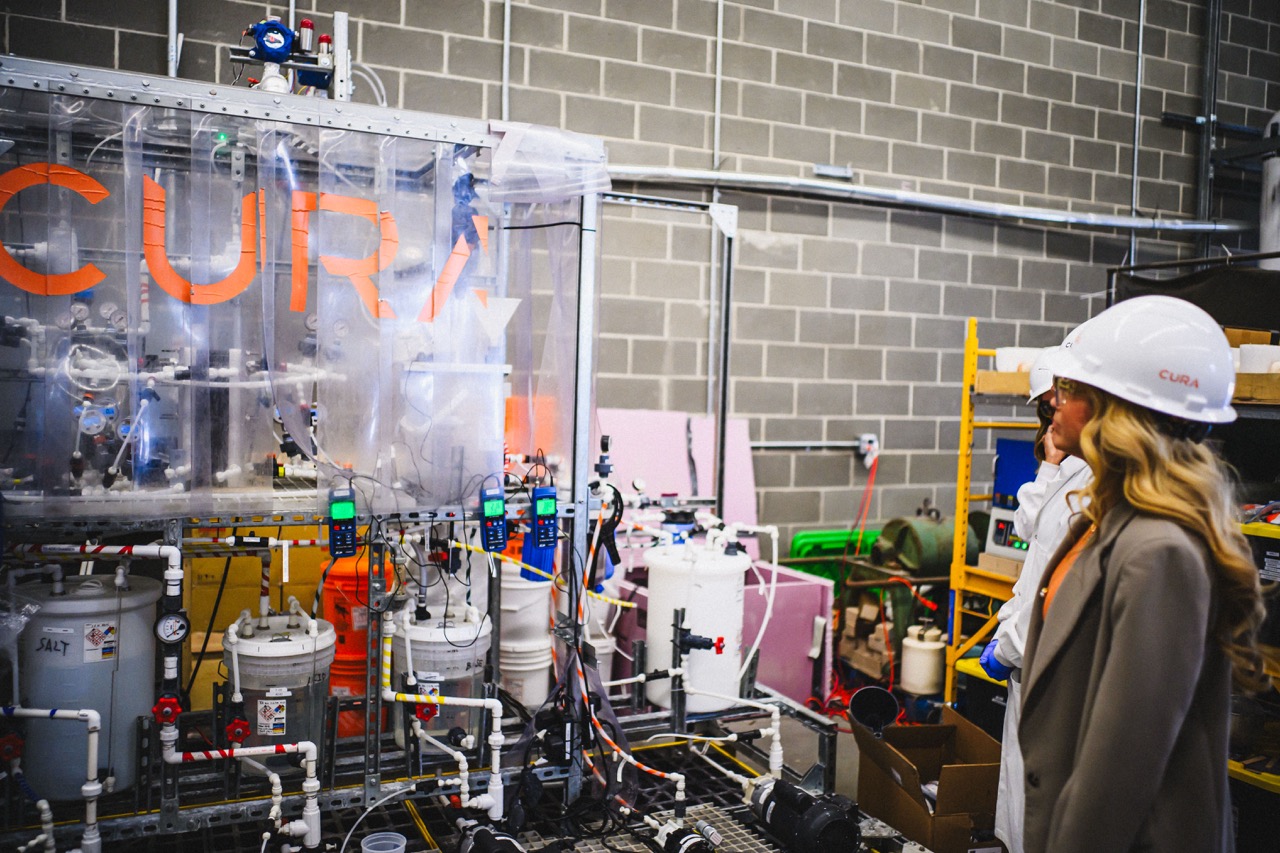
Electrochemical reactor for low-carbon cement production and carbon capture
Hamburg, 19 October 2026. Cement underpins nearly everything we build, and it also accounts for roughly 8% of global CO₂ emissions. Most of those emissions are released by the chemistry of making cement rather than by burning fuel. CURA, the Calgary-based industrial decarbonization company, comes to Hamburg Messe this week to show how that process can be changed at its source, and to build the partnerships needed to take its technology from pilot to global deployment.
Tackling cement’s hardest emissions at the source
When limestone is heated to make lime, the reaction itself releases CO₂. This is calcination, and it accounts for a large share of cement’s carbon footprint. Switching to cleaner fuels does nothing to remove these emissions. Conventional carbon capture tries to recover the CO₂ afterwards from hot, dilute flue gas, which is costly and energy-intensive.
CURA works further upstream. Its electricity-powered, electrochemical process splits limestone into a low-carbon lime product and a separate stream of pure CO₂, ready for storage or use. The technology can cut cement emissions by up to 85%. It is designed to retrofit into existing cement and lime plants, so producers keep their current feedstocks and infrastructure. CURA’s aim is for producers to make cement and manage their carbon at the same cost they do today, or less.
"Cement is one of the hardest climate challenges left to solve. The world has trillions of dollars invested in existing cement plants, and our technology is built to work with that infrastructure, not replace it. Hamburg is where we want to find the partners who will help us bring this to plants around the world.” Says CURA CEO and co-founder, Erin Bobicki
Momentum heading into Hamburg
CURA was founded in 2025 by Erin Bobicki (CEO),Sabrina Scott (COO), and Phil De Luna (CTO). It has moved quickly since then:
- Funding: CURA closed a US$10 million funding round to accelerate commercial development and build a pilot plant in Alberta, Canada.
- Membrane technology: CURA is working with electrochemical membrane partners globally. Testing so far has shown record-low operating voltages.
- First commercial project: CURA signed an agreement with Grand Forks Concrete Ltd. to build a pilot and first-of-a-kind commercial plant. The plant will turn agricultural spent lime into low-carbon cement.
Who CURA wants to meet in Hamburg
The team’s goal at this year’s Expo is to form strategic partnerships in four areas.
Cement equipment manufacturers. CURA wants to work with original equipment manufacturers (OEMs) and engineering firms on designing, integrating and supplying equipment for retrofitting CURA systems into existing kilns and calciners. The aim is a standardized, repeatable integration package that cement and lime producers can adopt with confidence.
Electrochemical technology providers. The process depends on efficient, durable electrochemical components. CURA wants to meet suppliers and developers of electrolyzers, membranes, electrodes and power systems.
Cement and concrete producers. CURA is looking for producers interested in hosting demonstration and early commercial deployments, and for concrete companies looking to secure low-carbon cement supply. Early partners will help shape how the technology is integrated and scaled.
Carbon capture, transport and storage companies. The process yields a concentrated, pure CO₂ stream, which makes downstream handling simpler. CURA wants to partner with companies across the CO₂ value chain, covering conditioning, transport, permanent storage and utilization, so that every tonne of separated CO₂ goes to a verified, permanent destination.
Meet CURA at the Expo
Carbon Capture Technology World Expo runs from 20 to 22 October 2026 at Hamburg Messe, alongside Hydrogen Technology World Expo. CURA’s team will be at Hall B3, Stand 3A35 throughout the event to talk through the technology, its pilot roadmap and partnership opportunities.