


EVS Hydrogen presents its H2 multifuel GenSet for the first time.
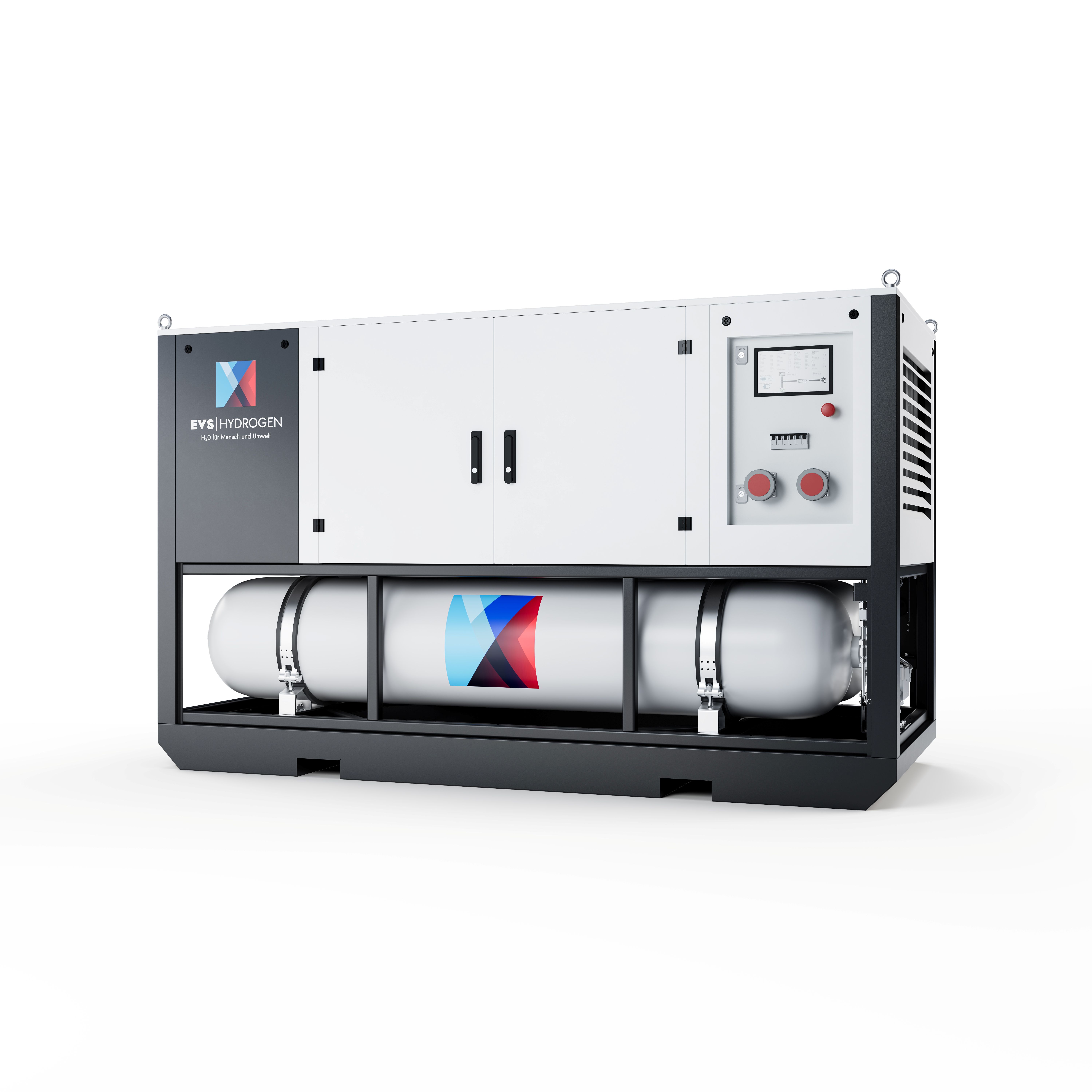
EVS Hydrogen GmbH will present the GENSET 450 at the Hydrogen Technology Expo Europe in Hamburg: a hybrid, battery-buffered power generator with its own hydrogen engine that can run CO2-free on green hydrogen and CO2-neutral on other fuels. A continuous engine output of 25 to 75 kilowatts delivers a grid-side peak output of up to 200 kVA – opening up an application field that has so far been covered by neither conventional diesel generators nor fuel cells.
A New Application Field for Hydrogen
Hydrogen is currently viewed mainly in two ways: as a fuel for mobility and as a feedstock for stationary fuel cells. The space in between – decentralized, grid-forming power generation with high short-term peak output – has so far remained largely unaddressed.
This is precisely where the GENSET 450 comes in. It is not a standby generator that sits idle alongside the grid, but a unit that forms its own grid, supports an existing grid, and can also absorb surplus energy. If the grid fails, the same unit continues operating without interruption in island mode. No second unit, transfer switch, or separate uninterruptible power supply is required.
For hydrogen, this opens up an additional market: not as a niche fuel, but as the operating fuel for a decentralized generation unit capable of supporting entire grid sections as part of a network.
High Peak Output from a Compact Unit
The engine runs at variable speed and always at its efficiency optimum, regardless of the output currently being delivered. This eliminates the partial-load operation that puts a strain on conventional generators over extended periods.
Peak loads are handled by a battery buffer, which is deliberately designed as a power buffer rather than an energy store: it absorbs load spikes instantly, with the engine following shortly after. This allows a unit with 50 kilowatts of continuous engine output to achieve a performance level that would conventionally require a unit in the 150 kVA class – with significantly lower fuel consumption and significantly lower emissions.
Continuous output, peak output, and hold time go hand in hand: 25 / 50 / 75 kW continuous engine output, up to 200 kVA grid-side peak output, and around 30 minutes of hold time from the buffer at approximately 175 kVA.
One Unit, Multiple Fuels
The GENSET 450 is not tied to a single fuel. In addition to hydrogen, it is designed to run on methanol, ethanol or E85, gasoline, LPG, and natural gas or biomethane. Ammonia is being prepared as a further operating fuel.
The fuel used determines the CO2 balance, not the choice of unit. If the preferred fuel is not yet available at a given site, the same unit can be operated temporarily on an available alternative. This means operators do not have to commit today to an infrastructure that will only be widely available in a few years.
The fuel modules are designed to be interchangeable: pressure tanks for 350 bar are integrated into the frame's underbody in the hydrogen configuration, while the liquid-fuel configuration uses tank modules of the same design.
For hydrogen operation, purity grade is not critical: the engine runs reliably on hydrogen of both grade 2.0 and grade 5.0, and even minor traces of moisture in the gas do not affect operation.
The system pressure is around 12 bar, compared with the 60 bar typically required by other systems. This allows the hydrogen cylinder to be discharged significantly further.
Application Fields
Grid-forming operation, high peak output, and fuel flexibility combine to create seven application fields:
▪Building energy station – combined power and heat generation, particularly for properties with photovoltaic systems.
▪Uninterruptible backup power – seamless load takeover for hospitals, data centers, and other critical infrastructure, without the need for a second system.
▪Decentralized grid stations and smart grid – self-sufficient unit combining photovoltaics, buffer, and generator for utilities, municipalities, and off-grid regions.
▪Charging infrastructure – three-digit kilowatt charging capacity at sites without adequate grid connection.
▪Construction site and event power supply – high start-up peaks with low continuous load, running almost silently in pure buffer mode.
▪Telecommunications – uninterruptible power supply for mobile network sites and network nodes away from the public grid.
▪Service vehicles for grid maintenance – mobile deployment during grid maintenance work, able to absorb surplus generation instead of curtailing it.
In addition, there is mobile grid support: grid sections currently served by mobile diesel generators during maintenance work – here, the GENSET 450 can absorb surplus generation on site instead of curtailing it via frequency response.
“The market discusses hydrogen almost exclusively in terms of production and fuel cells. In Hamburg, we're showing the other side: a unit that actually converts hydrogen into grid power, and does so with a peak output you wouldn't expect from a generator of this size.”
Walter Seidl, Managing Director of EVS Hydrogen GmbH
On Display at the Trade Fair
EVS will be present at the Hydrogen Technology Expo Europe from 20 to 22 October 2026 at Hamburg Messe – together with Bayern Innovativ at the Bavarian joint stand (Hall B6/M48).
On display will be the hydrogen engine as well as, for the first time, the GENSET 450 built around it. Meeting appointments at the stand are available on request.
Technical Specifications at a Glance
Specification
Design
Hybrid power generator with DC-coupled architecture
Engine
Variable-speed hydrogen engine with multi-fuel capability, developed in-house by EVS
Fuels
Hydrogen, methanol, ethanol or E85, gasoline, LPG, natural gas or biomethane; kerosene; ammonia in preparation
Continuous engine output
25 / 50 / 75 kW (three scaling levels)
Grid-side peak output
up to 200 kVA; approx. 175 kVA for around 30 minutes from the buffer, depending on battery capacity
AC output
400 V, three-phase, 50 Hz (60 Hz on request)
Battery buffer
Battery systems with high peak-load capability
Operating modes
Grid-parallel, island mode, hybrid, peak shaving, pure buffer mode, charging
Grid connection
Bidirectional, grid-forming, integrated grid and system protection per VDE-AR-N 4105
Hydrogen storage
350 bar pressure tanks, integrated into the frame underbody, modular tank system for flexible application adaptation
CO₂ emssions
CO2 -free operation with green H2
Preliminary figures from ongoing development; non-binding. The system is currently at prototype stage, with type approval in progress. Details of control and regulation methods are deliberately not included, as related patent applications are pending.
About EVS
EVS Elektronik Walter Seidl and EVS Hydrogen GmbH, based in Untergriesbach (Bavaria, Germany), develop and manufacture drive and energy conversion technology. The company's development work centers on its proprietary multi-fuel engine and its integration into decentralized, grid-forming energy systems.
Several of the processes implemented in the GENSET 450 are patent pending.