



IPS Elektroniklabor: System solutions for hydrogen research
At the Hydrogen Expo Hamburg, IPS Elektroniklabor GmbH & Co. KG will showcase its expertise in two key areas of hydrogen research: the measurement of hydrogen permeation and hydrogen embrittlement in metallic materials, as well as the design of complete system solutions that integrate existing testing machines with state-of-the-art hydrogen technology. Visitors will learn about the available measurement methods, the effort each requires, and how these can be used to develop customized, safely operable test stands.
IPS Elektroniklabor at the Hydrogen Expo Hamburg: From Lab Testing to a Safe Hydrogen Test Bench
IPS Elektroniklabor GmbH & Co. KG is exhibiting at the Hydrogen Expo Hamburg, where it is showcasing its expertise in two closely related areas of hydrogen research: the measurement of hydrogen permeation and embrittlement, and the development of complete system solutions for testing materials in a hydrogen atmosphere.
Hydrogen permeation and H₂ embrittlement: from the simple measuring cell to the high-pressure system
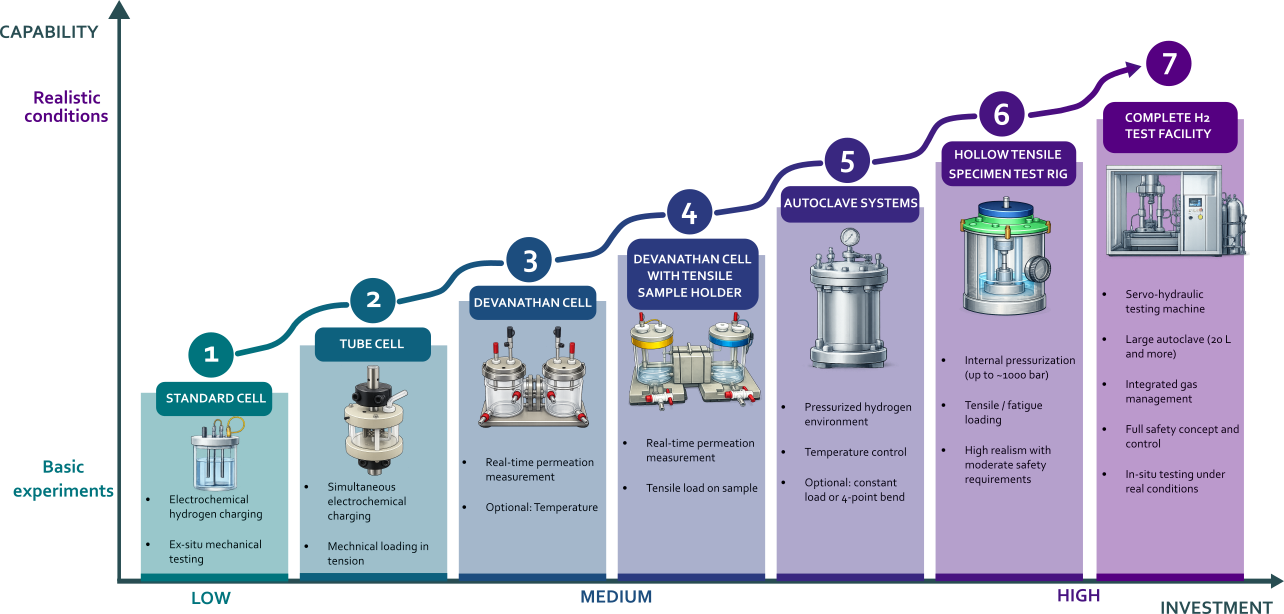
When hydrogen diffuses into metallic materials, it can significantly weaken their strength – an issue that is just as relevant to electroplating specialists as it is to anyone who needs to qualify components and materials for use in hydrogen applications. IPS Elektroniklabor has developed a guide on this subject, which categorizes the common system variants used to investigate hydrogen permeation and embrittlement – ranging from simple electrochemical methods to complex high-pressure test rigs.
At the lower end of the spectrum is the combination of a potentiostat/galvanostat and a standard measuring cell: a specimen is cathodically polarized, producing hydrogen which diffuses into the material; the tensile test then reveals whether a brittle fracture occurs. A Devanathan cell allows the hydrogen-induced current to be measured directly and continuously, whilst hydrogen is generated on the charging side of the specimen; optionally at a controlled temperature and under mechanical tensile loading where the potentiostats, used for this process can also be employed to investigate Carbon capture while simultaneously determining the electrochemical pH value. For more demanding requirements, IPS Elektroniklabor offers the TubeCell, a solution that combines electrochemical loading and tensile testing in a single step, thereby significantly reducing the test time.
At the top end of the scale are testing systems using molecular hydrogen under pressure: ranging from compact autoclaves, through hollow specimen technology with internal pressures of up to 1,000 bar, to complete systems comprising a tensile testing machine, autoclave, gas management system and safety-related PLC control for in situ testing under pressure and temperature loads.
System solutions: integrating existing testing technology with hydrogen technology
Going beyond mere measurement methods, IPS Elektroniklabor develops complete system solutions that integrate existing test machines with state-of-the-art hydrogen technology. The process ranges from requirements analysis through design and engineering, including the design of autoclaves, gas management and safety systems, to manufacturing, commissioning and ongoing customer support. With more than ten years of experience in the construction of hydrogen test benches, IPS Elektroniklabor delivers customized solutions for research institutes, universities and industrial development departments. Several systems are already in continuous operation, including 1,000-bar test benches in Darmstadt and Berlin.
Visit our stand
At the IPS Elektroniklabor stand at the Hydrogen Expo Hamburg, interested parties from the worlds of research and industry can find out about suitable measurement methods for their specific research questions, as well as the possibilities for customized system solutions.
Hall: B6 Stand: 6B25
About IPS Elektroniklabor
IPS Elektroniklabor GmbH & Co. KG develops and manufactures electrochemical measurement technology and system solutions for hydrogen and corrosion research – ranging from potentiostats/galvanostats and measuring cells to complete, safety-critical test benches for hydrogen atmospheres and high-pressure applications. The company has more than ten years of experience in the construction of hydrogen test benches and supports research institutes, universities and industrial partners in Germany.
Am Eppertshäuser Pfad 2, 64839 Münster (Hesse)