




Permanent magnetic couplings: central component in facing the challenges of hydrogen economy
The successful implementation of this technology requires significant progress in all areas of the hydrogen economy, from production to storage and transport. Permanent magnetic couplings, such as those developed and manufactured by DST, hold a central position in this context.
Technological basics and areas of application
DST is an international manufacturer of high-performance permanent magnetic couplings with a standard range of 1–1,200 Nm and customised solutions from 0.1 to max. 25,000 Nm. An extensive programme of conversion kits for pumps, assemblies for agitator drives and a large selection of canister materials complete the product range. Permanent magnetic couplings from DST are indispensable for environmentally friendly drive solutions. Thanks to their contactless and leak-free torque transmission in pumps and agitators, they are a reliable alternative to conventional dynamic seals.
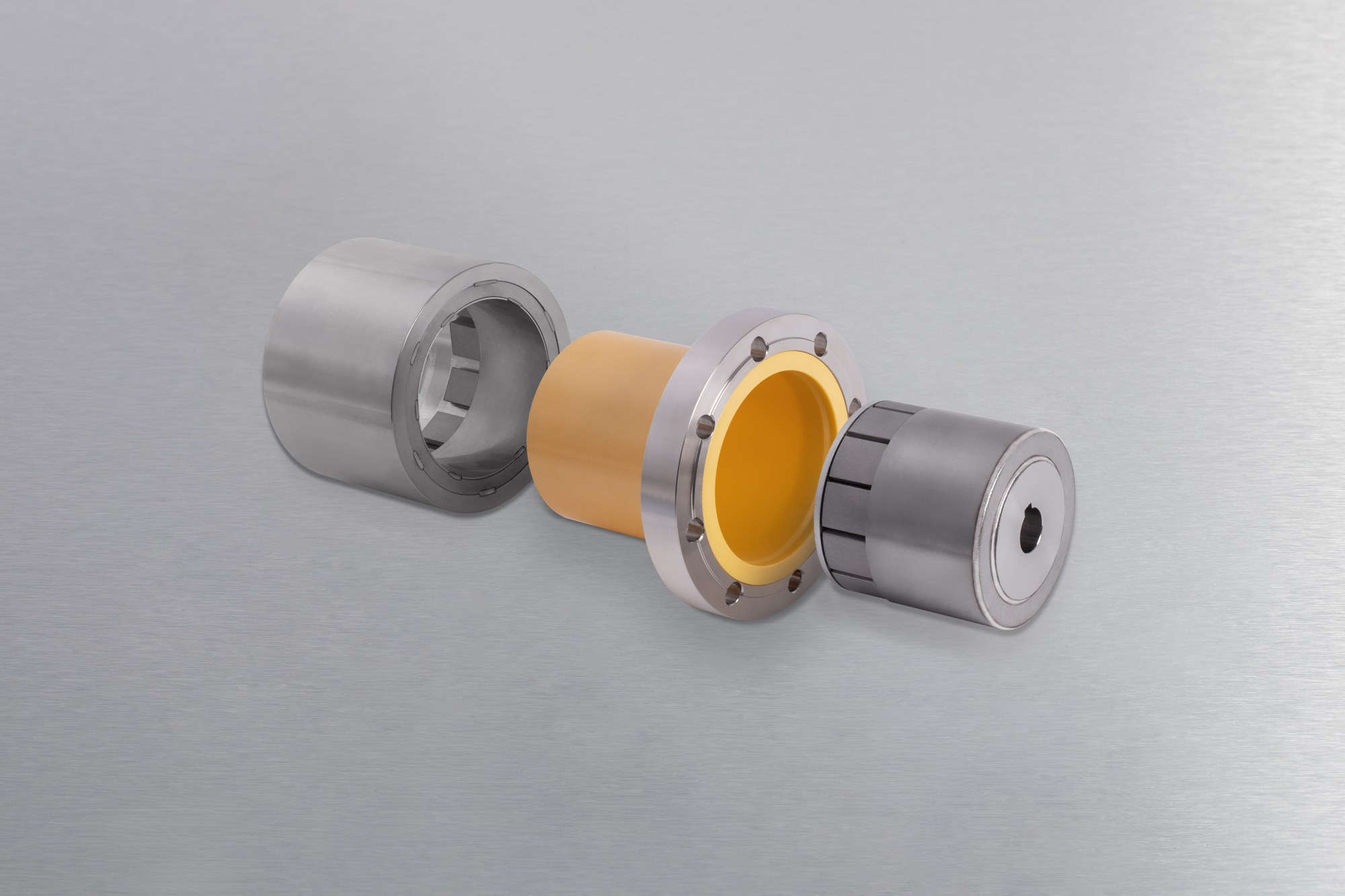
With permanent magnetic couplings, the torque of the driving side is transmitted to the driven side by magnetic force without contact. The coupling consists of an inner and an outer rotor equipped with permanent magnets in alternating polarity. The outer rotor transmits the drive torque directly to the inner rotor connected to the driven side. The canister is located between the inner and outer rotor and is sealed using a static seal like an O-ring or gasket, which prevents the operating medium from escaping from the coupling and posing a risk to people and the environment. This achieves a 100% hermetic seal.
Permanent magnetic couplings are used in a wide range of industries worldwide, including the chemical, pharmaceutical and food industries, as well as applications in biotechnology, industrial furnaces, water management, compressors, measuring and dosing technology, hydraulics and petrochemicals. The effectiveness of permanent magnetic couplings is most notable in their use within critical areas. Their ATEX certification further confirms their suitability for use in environments with a potential for explosions.
The canisters are a key element in the design of the permanent magnetic couplings, as they enable 100% hermetic sealing of chemicals from the environment. With the ever-increasing demand for reducing the carbon footprint, the use and demand for hydrogen for different applications are increasing really fast. Especially for manufacturers of compressors, booster plants, agitators or pump systems. The risk of hydrogen diffusion makes the selection of the material very crucial. DST offers a wide range of materials for these canisters, including various metals and high-performance plastics. The selection of the right material mainly depends on the chemical resistance, the strength under pressure and the temperature tolerance of the material. Working in close cooperation with their customers, DST has proven solutions for hydrogen.
The importance of permanent magnetic couplings in hydrogen supply chain
Storage and transport
The storage and distribution of hydrogen poses a significant challenge due to its physical properties. Hydrogen's low energy content by volume makes it uneconomical to store and transport hydrogen in its normal state. To transport hydrogen economically, it needs to be converted either to a compressed gas, liquid form at subzero temperatures or chemical derivatives. These processes require precise and reliable technologies to safely handle the converted hydrogen or its derivatives.
Application example: long-term storage for green hydrogen
A concrete application example of the importance of permanent magnetic couplings in hydrogen technology is their use in long-term storage systems for green hydrogen. These systems are essential for storing surplus energy from renewable sources such as wind or solar energy. By converting this energy into hydrogen using electrolysis and then storing it, the energy can be conserved over long periods of time and converted back into electricity when required.
At the heart of such a long-term storage system is the compression unit, which pressurises the hydrogen produced to a level that enables it to be stored in tanks. The efficiency of the compression is of crucial importance here to minimise energy loss and maximise storage capacity. The permanent magnetic couplings ensure optimum compression performance thanks to their contactless and efficient power transmission. Their ability to eliminate the risk of leakage is particularly invaluable when handling hydrogen, as any form of gas leakage not only leads to energy loss but also poses safety risks.
Additionally, this hermetic separation protects the compressor and the entire system from contamination and ensures pure hydrogen quality, which is essential for the efficiency of reconversion and for applications where pure hydrogen is required.
Ammonia as a hydrogen carrier
To transport hydrogen over long distances, a lot of energy is required. The hydrogen gas would need to be cooled down in its liquid state at subzero temperatures. The process of converting hydrogen gas into liquid form is expensive and the infrastructure needed for it is not yet completely established. Additionally, the whole process is energy- and cost-intensive. A solution to this is to use a chemical derivate of hydrogen, which requires less energy for liquefaction and can be easily transported. Ammonia is one of the highly used chemicals in the industry for which an infrastructure already exists. Additionally, ammonia has a higher energy density than hydrogen. In simple words, more energy can be transported for the same volume. Once the ammonia reaches its destination, it can be broken down to generate hydrogen.
The process begins with the synthesis of hydrogen, usually by electrolysis, followed by the reaction of the hydrogen with nitrogen using a catalyst to produce ammonia. The permanent magnetic coupling comes into play by transferring the energy from an external source, such as an electric motor, to the reactor where the synthesis takes place. This transfer must be extremely precise to ensure the optimum reaction condition and maximise the efficiency of the process. The use of permanent magnetic couplings in this context offers several advantages: it provides a hermetic separation between the motor and the reaction chamber, eliminating the risk of contamination or leakage that could disrupt the process.
The produced ammonia would need to be loaded onto the sea vessels with big storage tanks, for which pumps are required. Ammonia is toxic, flammable and harmful to human life. Thus, a safe and reliable pumping of ammonia is of utmost priority. Here again, permanent magnetic couplings provide the safety of a leak-free operation. The permanent magnetic coupling comes into play by transferring the energy from an external source, such as an electric motor, to the pump.
Thus, at every stage of the process, a safe and reliable operation is ensured by the use of a permanent magnetic coupling.
Cost benefits
The integration of permanent magnetic couplings as an alternative to conventional seals is not only a step towards technological innovation but also a strategic move in terms of long-term cost optimisation and improved operating efficiency.
Considering the amortisation costs over the service life of the system, it is clear that opting for permanent magnetic couplings can offer considerable cost benefits. In particular, the longer service life of these couplings compared to conventional seals is a decisive factor. Due to their robust design and reduced susceptibility to wear, companies need to invest less in replacing worn parts or seals. This not only has a direct financial impact through savings in maintenance costs, but also minimises system downtime. Less downtime means higher plant availability and increased productivity, which in turn leads to further financial savings and increases the profitability of the operation.
Another important cost factor to consider is energy loss. Conventional seals can lead to significant energy losses, especially in high-pressure or high-speed applications. Thus, to transfer the effective torque, more energy is required. The contactless torque transmission eliminates the energy loss due to friction. However, as with any other product, the permanent magnetic couplings also have losses, which are defined as eddy current losses. Depending on the operating parameters, eddy currents are induced in an electrically conductive object, such as a metallic canister in a rotating magnetic field. The consequence is eddy current losses, which reduce the torque transmission capacity of the permanent magnetic coupling and lead to additional heat generation. Thus, a larger motor must be used to compensate the energy loss and an additional cooling measure is required. In order to keep energy consumption as low as possible, the choice of material is important. DST offers high-performance canisters in ceramic material to completely eliminate eddy current losses. Thus, providing the customers with a very highly efficient system. This reduction in energy loss results in lower operating costs and offers companies the opportunity to realise long-term savings, especially in industries with high energy consumption.