


Reliable Aging Tests for Electrolyzer Stacks
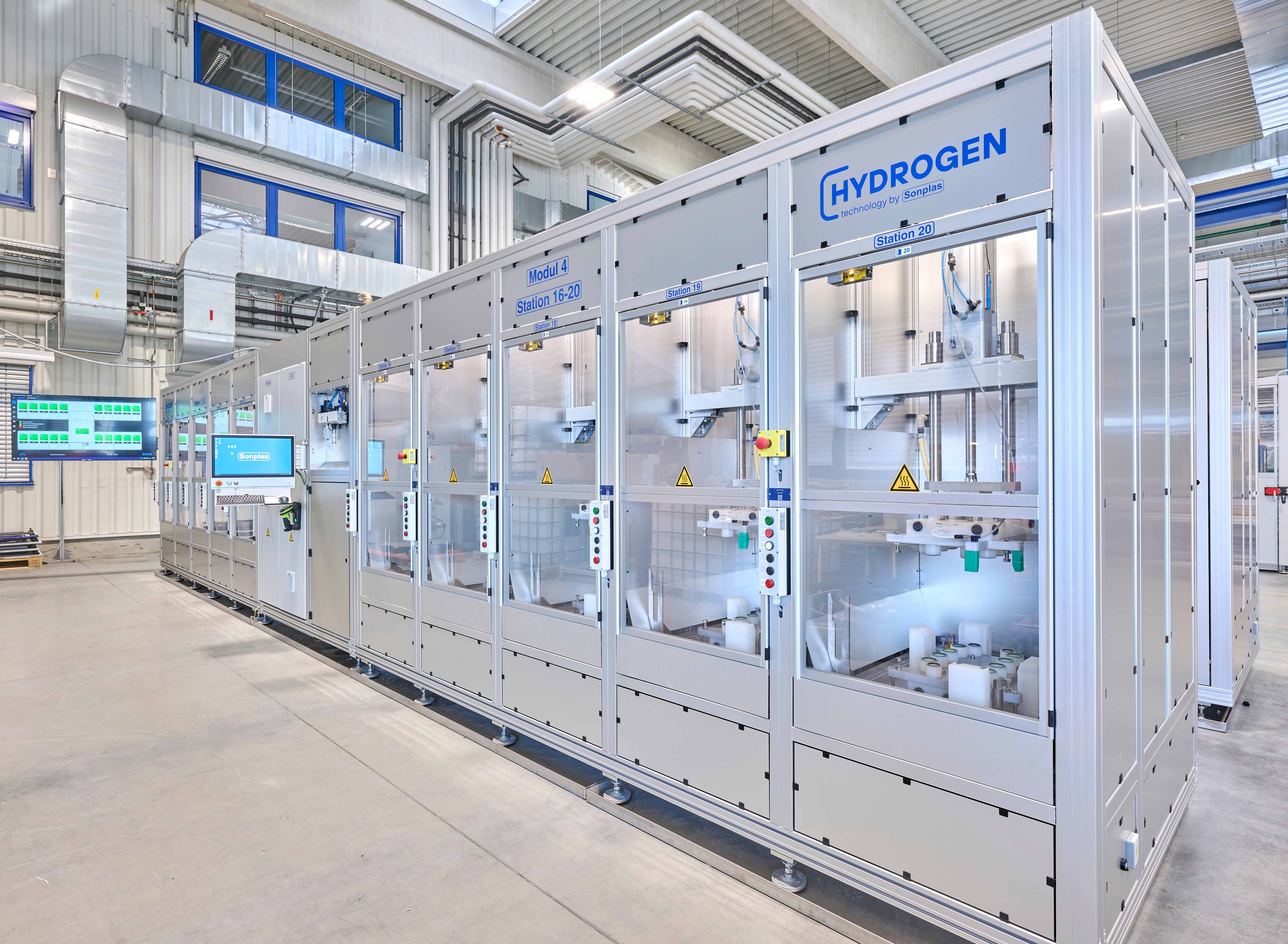
The effects of aging in electrolyzer stacks often don't become apparent until later in the operating life of the system. Sonplas develops modular test systems that enable manufacturers and research organizations to identify and analyze these effects early under controlled conditions. By combining advanced testing technology with an inerted thermal chamber, Sonplas provides a safe environment for evaluating aging and safety risks in the laboratory. This enables faster, more consistent, and more reliable development cycles. As a development partner, Sonplas also applies its expertise to a wide range of next-generation propulsion technologies.
Electrolyzer stacks produce green hydrogen using water and renewable electricity. The primary electrolysis technologies include proton exchange membrane (PEM), alkaline (AEL), and anion exchange membrane (AEM) electrolysis. As the core of an electrolyzer, the stack is a key factor in determining system performance, efficiency, and service life. It is essential for industrial applications, energy storage, and sustainable mobility.
Until recently, many manufacturers relied primarily on field testing to evaluate electrolyzer stacks. Prototype stacks were installed in complete systems, with performance assessed later based on operating data. While this approach provides valuable real-world insights, it is time-consuming, resource-intensive, and carries risks. "In many cases, failures don't become apparent until the system is already in operation," says Florian Hubner, Project Manager for Hydrogen Technology and Test Systems at Sonplas. Based in Straubing, Germany, Sonplas designs and builds customized assembly and testing systems for a wide range of industries.
Combining Advanced Testing Technology with an Inerted Thermal Chamber
"Our modular test systems take a different approach," says Hubner. "A key differentiator is the integration of an inerted thermal chamber." This enables manufacturers to evaluate not only functional performance, but also service life and aging under controlled conditions. The thermal chamber simulates realistic temperature environments for testing with hydrogen and other critical media. Sonplas designs these chambers for use in hazardous environments where explosive atmospheres may be present. The chamber surrounds the test specimen with a controlled inert atmosphere, using nitrogen to minimize risk during testing. It combines precise temperature control, mechanical stability, and the flexibility to accommodate a wide range of test configurations. "Users can apply targeted loads to electrolyzer stacks, continuously monitor their performance, and test them up to defined operating limits," explains Hubner. This gives manufacturers and research organizations earlier access to reliable data for material selection, technology validation, and service life assessment.
Membranes and Materials Under Load
Hydrogen production is advancing rapidly. Many technologies—particularly new stack designs and material combinations—still require significant development. Manufacturers need to understand how their systems will perform over the long term. An electrolyzer stack operates under demanding conditions. Pressure, temperature, process media, and electrical loads continuously act on its components. The membrane is a critical component, separating the reactant streams while playing a key role in determining overall system efficiency.
Over time, hydrogen crossover into the oxygen stream can increase. Initially, the effect is minimal, but as the stack ages or materials begin to degrade, it becomes more pronounced, reducing performance, shortening service life, and compromising safety.
Leaks and material incompatibilities are additional potential failure modes. In the field, they can result in significant downstream costs. Replacing a stack at remote sites—such as wind farms or solar installations—requires substantial service effort and expense. Identifying these issues early through laboratory testing allows manufacturers to manage these risks far more effectively. "A simple functional test is no longer enough to support the development of next-generation electrolyzer stacks ," says Hubner. Manufacturers need test systems that enable accelerated stress testing under realistic, controlled conditions.
Short Stacks Enable Reliable Service Life Evaluation
Large electrolyzer stacks can have electrical input ratings in the megawatt range. Testing these full-scale systems on a single test system is rarely practical or cost-effective. Instead, developers use short stacks—smaller assemblies with fewer cells that replicate the key characteristics of the final system. "Short stacks allow developers to directly compare materials, cell designs, and operating strategies," explains Hubner. "They provide a practical and cost-effective way to evaluate how individual parameters influence performance and aging."
Sonplas test systems capture a wide range of measurement data and support diverse testing applications, including leak testing, dynamic pressure measurement, flow characterization, electrical testing, and concentration analysis. The key advantage is early validation. Manufacturers can identify potential issues long before a complete electrolyzer begins to show signs of degradation in the field. They can also detect critical interactions early in the development process. This accelerates decision-making and reduces technical risk.
Built for Multiple Technologies
Each electrolysis technology has its own requirements for materials, process media, temperature control, and test methodology. In PEM electrolysis, for example, high-performance materials account for a significant share of system cost. This raises a key question for manufacturers: How can they create the right testing environment without being constrained by standardized test equipment? Sonplas addresses these challenges with modular test system concepts. Rather than offering a one-size-fits-all solution, the company analyzes each customer's specific requirements and configures the test system accordingly.
This modular approach can be adapted to a wide range of performance levels and expanded with optional modules for process media, safety, and data acquisition. Sonplas combines these modules to meet each application's specific requirements. As a result, the company serves not only as an equipment supplier, but also as a development partner for research and industrial applications.
Modular Solutions for Research and Industrial Applications
"Right now, we're seeing the strongest interest in these test systems from research organizations," says Hubner. "Universities and research institutes are using them to investigate new materials, cell designs, and aging mechanisms. We also expect manufacturers to increasingly bring this type of testing in-house."
Fuel cells are typically qualified for service lives of up to 25,000 hours. For electrolyzer stacks , however, the industry is targeting significantly longer operating lifetimes. Another challenge is dynamic operation. Rather than running under steady-state conditions, electrolyzers must respond to the fluctuating availability of wind and solar power. As a result, manufacturers need test systems that support long-duration testing and deliver reliable, repeatable measurement data.
"The electrolysis market is evolving rapidly, and its development is anything but linear," explains Hubner. "Some projects are driven by large industrial companies, while others come from research consortia or technology startups. As a result, requirements vary widely." One example is a custom-configured test system that Sonplas developed for a cement plant operator. This project focuses on converting carbon dioxide into ethylene through electrolysis. Although the application differs from conventional hydrogen production, it requires many of the same core capabilities in process media management, material compatibility, and safe process integration. "This project demonstrates the versatility of our testing technology," says Hubner. "We support research organizations and industrial partners as new processes transition from the laboratory to real-world applications."
From Test Systems to Development Partnerships
Sonplas also adapts its testing solutions to emerging propulsion technologies, supporting customers as a development partner throughout the innovation process. "No one can predict every testing challenge the future will bring," concludes Hubner. "That's why the industry needs partners who are ready to tackle new challenges as they emerge." This testing approach helps engineers better understand electrolyzer stacks , identify potential risks earlier, and lay the foundation for durable systems that reliably produce green hydrogen.
At the Hydrogen World Expo Sonplas will showcase an actual test bench for AEM electrolyzer stacks.