



Scribner Introduces the 830: A New Path from Lab-Scale Research to Industrial-Scale Testing
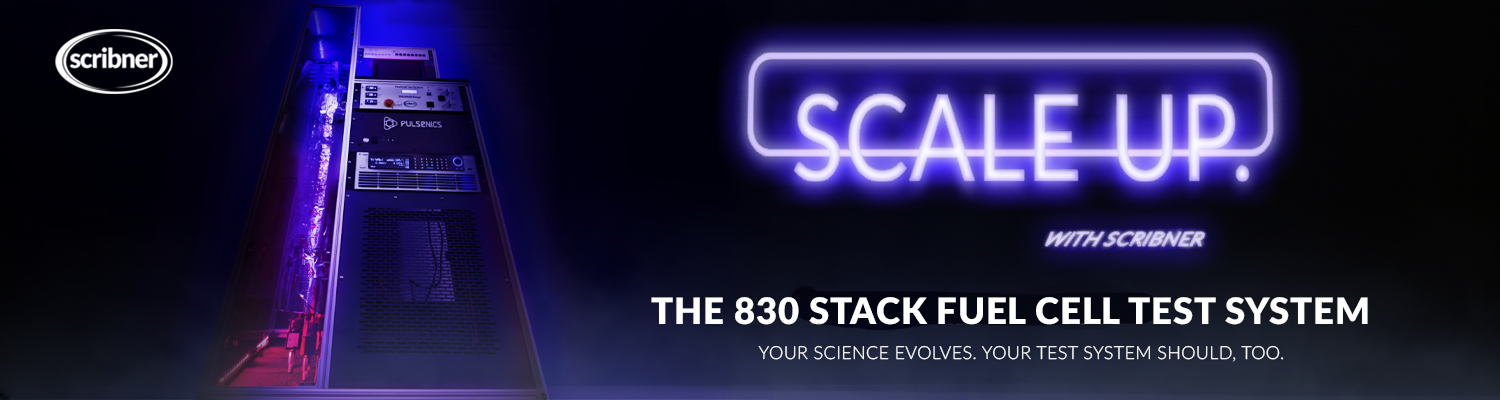
Scribner, leader in electrochemical testing and instrumentation, today announced the launch of the 830 Stack Fuel Cell Test System, a fully automated, turnkey platform designed to help research and development teams move fuel cell technology from laboratory research toward larger-scale development and industrial applications. Exclusively unveiled at Hydrogen Technology Expo Europe in Hamburg, the 830 reflects Scribner’s commitment to empowering electrochemists with the tools they need to take their science further. The 830 brings together Scribner’s 40+ years in electrochemical testing equipment and Pulsenics’ industrial EIS diagnostics in one platform, with service and support from both teams.
Built around a modular and scalable architecture ranging from 2 kW to 10 kW+, the 830 is designed for testing both large-format single cells and full fuel cell stacks. It gives R&D teams the flexibility to scale their testing as their technology matures without having to leave behind the testing platform, software and expertise they already rely on.
“At Scribner, our mission is to empower electrochemists by providing tools that instill confidence and capability as ideas transform further,” said Russell Freed, General Manager of Scribner. “The 830 is a direct expression of that mission. We built it so researchers don’t have to wonder if their testing platform can keep up with where their science is going. They can start with the research they’re doing today and have a clear path to scale tomorrow.”
For scientists, the challenge isn’t simply making a fuel cell work. It’s understanding how that technology performs over time, how individual cells behave within a stack, and how the system responds as it moves from the laboratory toward real-world operating conditions. The Scribner 830 Stack Fuel Cell Test System was designed specifically for that next stage.
With capabilities for long-term, unattended operation and performance characterization, the system integrates process gas control, system parameters, external sensors, electronic load configurations, cell voltage monitoring and advanced diagnostic capabilities into a single testing platform.
FROM SINGLE CELLS TO FULL STACKS
The transition from laboratory-scale research to larger systems can introduce significant complexity. The 830 addresses that challenge with a modular architecture designed to grow alongside the technology being tested.
The system supports large-format single-cell and full-stack testing, with newly released Scribner stack fixtures designed for 3–10+ cells and a 100 cm² active area. The stack fixtures incorporate liquid cooling channels, optimized flow paths and low-resistance current collection to support meaningful stack-level testing.
This scalability gives researchers a pathway to move beyond individual cell performance and begin understanding what happens when their technology operates as a complete system.
SEE INSIDE THE STACK WHILE IT RUNS
A stack is only as healthy as its weakest cell. With integrated Pulsenics diagnostics, the 830 runs continuous EIS on the full stack and on each individual cell during operation. Researchers can separate ohmic, kinetic and mass transport losses, catch a failing cell early, and link degradation to operating conditions across long, unattended tests.
“Together with Scribner, we’re pairing their testing expertise with our EIS diagnostics in one integrated solution. Continuous, cell-level EIS shows researchers what’s happening inside the stack while it runs, not after something fails. And with unified service and support from both teams, that insight goes with them from the lab all the way to industrial scale.” said Essam Elsahwi, CEO of Pulsenics.
ADVANCED DIAGNOSTICS. LONG-TERM TESTING. ONE INTEGRATED PLATFORM.
The 830 is engineered for the kind of testing required as fuel cell development moves into increasingly demanding stages.
The platform combines robust controls, modular electronic load, cell voltage monitoring and optional Scribner Stack EIS. Furthermore, an optional Pulsenics Probe adds advanced, continuous EIS at both the stack and individual-cell level. Full software control provides automated management of process gases, system parameters and external sensors.
The system’s balance-of-plant architecture includes programmable high-power DC electronic loads, configurable humidification supporting up to 1,000 SLPM with less than ±2°C dew point accuracy, optional 10 bar back pressure, automated bypass, drain and fill functions, nitrogen purge and integrated process control.
At the center of the experience is FuelCell5®, Scribner’s integrated software platform for system control, experimental sequencing and analysis, alongside ZView® for impedance analysis and equivalent circuit modeling.
LEARN WHAT IT TAKES TO SCALE HYDROGEN R&D
To mark the launch of the 830 Stack Fuel Cell Test System, Scribner and Pulsenics will co-host an upcoming product launch webinar focused on the challenges and opportunities involved in taking hydrogen R&D from the laboratory to industrial scale.
The webinar will feature experts from Scribner and Pulsenics, exploring the value of manufacturer-integrated testing solutions and how advanced diagnostics can support the development of increasingly complex fuel cell systems.
Attendees will have the opportunity to:
- Hear from Scribner and Pulsenics about the value of manufacturer-integrated testing solutions.
- Ask experts questions about scaling hydrogen R&D from lab to industrial scale.
- Explore advanced diagnostics and long-term fuel cell testing.
- Discuss future projects and where stack diagnostics are headed next.
The launch webinar is an opportunity for researchers, engineers and R&D leaders to go beyond the product itself and explore what it takes to move electrochemical technology to the next level.
To register for the product launch webinar on Tuesday, November 10 at 9 a.m. ET, go here.
BUILT FOR WHAT COMES NEXT
The Scribner 830 Stack Fuel Cell Test System represents a new chapter in Scribner’s approach to electrochemical testing: providing researchers with a platform that can support their science not just where it starts, but where it is going.
From large-format single cells to full stacks. From short experiments to long-term unattended testing. From laboratory research to larger-scale development.
The Scribner 830 Stack Fuel Cell Test System is available for order now.
ABOUT PULSENICS
Pulsenics drives business transformation across the energy industry by enabling more reliable operation of electrochemical assets. Their next-generation performance diagnostics and quality control technologies, combined with industry-leading customer support, help energy companies replace legacy solutions with data-driven rapid insights. With commercial deployments spanning North America, Europe, Asia, Oceania, and the Middle East, Pulsenics supports leading organizations across the global energy transition. Scale with confidence. Learn more at www.pulsenics.com.
ABOUT SCRIBNER
Scribner designs and manufactures advanced electrochemical test equipment for fuel cell, electrolysis, redox flow, membrane, and battery research. With over 40 years of experience, Scribner is recognized for precision-engineered instrumentation, deep electrochemical expertise, thorough safety parameters, and responsive technical support. Scribner’s mission is to remove technical barriers and empower researchers to drive discovery, innovation, and impact. Serving laboratories and institutions around the world, Scribner builds lasting partnerships through reliable solutions, scalable systems, and a commitment to enabling scientific breakthroughs.
For all media inquiries, please contact info@scribner.com.