


ZBT at Hydrogen Technology World Expo 2026: Research, Testing and Solutions for Hydrogen Technologies
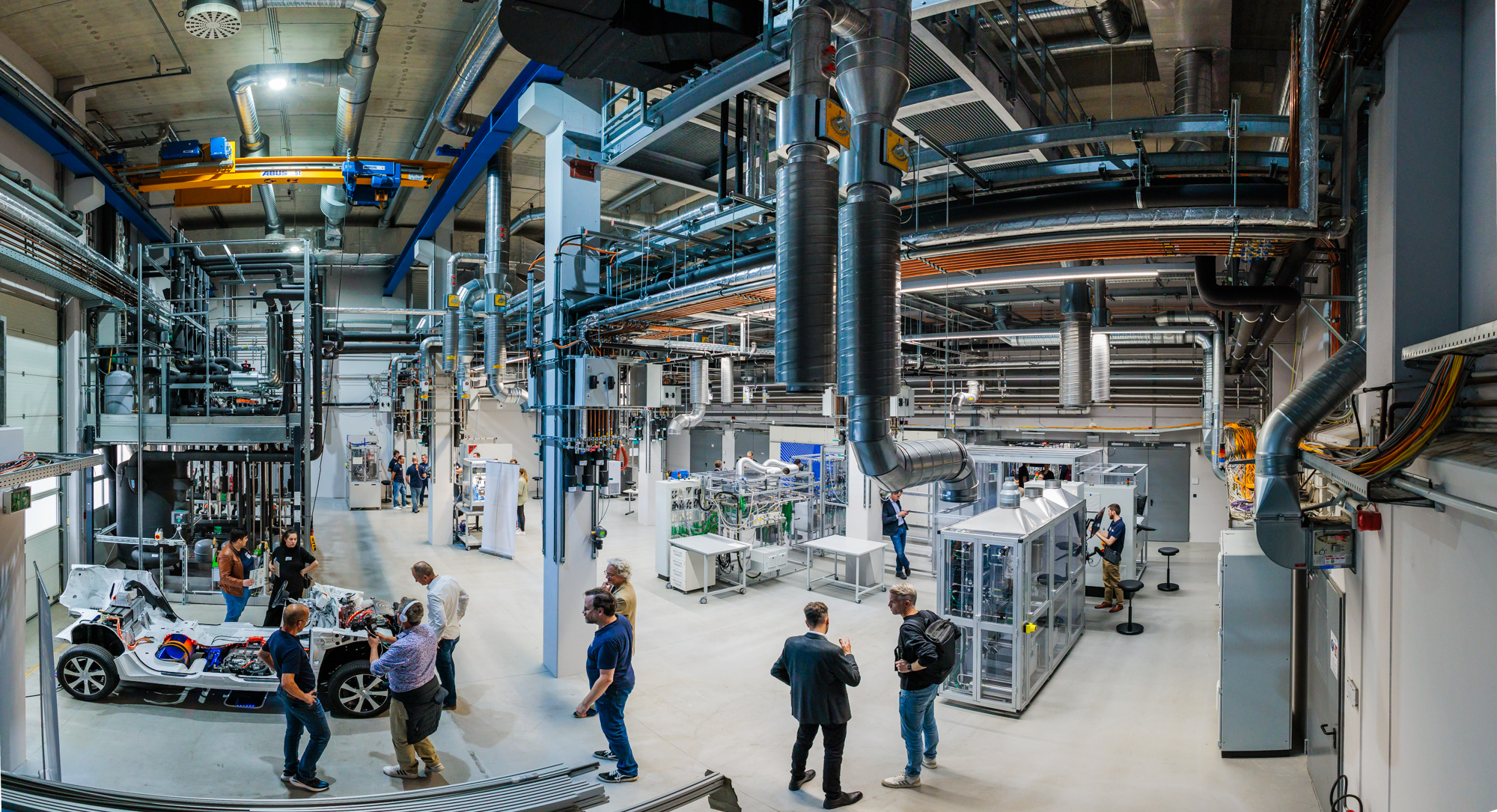
From 20 to 22 October 2026, the hydrogen industry will meet in Hamburg. For ZBT, this is one of the key opportunities to meet customers, partners and technology developers and talk about the challenges they encounter in practice: How can degradation be understood and reduced? How does a stack perform under realistic operating conditions? What happens to materials under thermal or electrochemical stress? How can hydrogen quality, safety and component reliability be verified?
These are exactly the kinds of questions ZBT works on every day. As an application-oriented research institute, we combine scientific expertise with extensive testing infrastructure and more than 20 years of experience in hydrogen, fuel cell and electrolysis technologies.
From materials to complete systems
Successful hydrogen technologies depend on many individual elements working together. A promising material needs to function in a component. A component has to prove itself in a stack. A stack has to remain efficient and stable under realistic operating conditions. And the complete system ultimately needs to meet requirements for performance, quality, safety and economic viability.
ZBT supports companies throughout this development process. Around 180 employees work on fuel cells, electrolysis, hydrogen production and infrastructure, energy carriers and related materials and manufacturing technologies. Our expertise ranges from material and component development to stacks and systems, manufacturing processes, modelling and simulation, analytical methods, testing and qualification.
This broad perspective allows us to investigate individual technical problems without losing sight of the application in which a technology ultimately has to perform.
How long will my electrolyser stack really last?
Performance at the beginning of a test is only part of the story. For electrolyser developers, operating strategies, efficiency, ageing, degradation and long-term stability are decisive when technologies move towards commercial application.
ZBT has recently brought a new 40 kW test bench for PEM water electrolysis into full operation. Following validation for pressurised operation, the facility is available for industrial testing as well as research and development projects. PEM electrolyser stacks can be investigated at up to 40 kW and 2,000 A, including long-term tests of up to 5,000 operating hours under demanding and application-oriented conditions.
This infrastructure complements ZBT's work across PEM and AEM water electrolysis, from catalysts, membranes and cell components to complete stacks and systems. Customers can use these capabilities to investigate performance and efficiency, identify degradation mechanisms, compare operating strategies and generate reliable data for further development and qualification.
What is happening inside my material?
Many performance losses and failures begin at material level. Understanding structural changes, phase transformations or ageing processes can therefore provide the information needed to improve a component long before problems become visible at system level.
ZBT has expanded its material analytics with a newly validated X-ray diffractometer (XRD). The system enables detailed characterisation of crystalline phases and structures in materials, coatings and catalysts. A high-temperature chamber additionally allows temperature-dependent in-situ XRD measurements at temperatures of up to 1,000 °C.
Researchers and industrial partners can therefore observe structural changes and thermally induced ageing processes while they occur. Combined with ZBT's electrochemical testing and extensive ex-situ and in-situ analytical capabilities, these measurements help connect material properties with component performance and degradation.
Which substances are present, and what do they tell us about degradation?
Purity and trace contaminants are becoming increasingly important throughout the hydrogen value chain. At the same time, new analytical questions are emerging around PFAS and the degradation of ionomer-containing materials in fuel cells and electrolysers.
ZBT is therefore further expanding the capabilities of its Hy-Lab hydrogen quality laboratory with a high-resolution HPLC-QTOF mass spectrometer. The new instrument will enable both precise quantification of known compounds and suspect and non-target screening for previously unidentified substances.
One important field of application is the investigation of ionomer degradation in fuel cells and electrolysers. Detecting degradation products can help identify mechanisms behind material ageing and provide a more comprehensive picture of potential contaminant release. The new system will complement ZBT's established expertise in analysing trace impurities in hydrogen and developing analytical methods for demanding hydrogen-quality requirements.
Bring us the problem you need to solve
Electrolyser lifetime, fuel cell performance, material degradation, hydrogen quality, manufacturing processes, infrastructure, safety or system integration: industrial development rarely stops at the boundary of a single discipline.
That is where ZBT's combination of research expertise and technical infrastructure becomes particularly valuable. We develop, manufacture, analyse, model, test and qualify technologies from the nano and material scale through components and stacks to complete systems and infrastructure. Projects can range from an individual measurement or testing assignment to longer-term R&D partnerships and jointly developed solutions.
At the Hydrogen Technology World Expo, we want to talk about exactly these challenges. Bring us the component that is not performing as expected, the degradation mechanism you cannot yet explain, the test you need for your next development step, or the technology you want to move closer to industrial application.
Meet ZBT and the partners of the MAT4HY.NRW collaboration platform in Hamburg from 20 to 22 October 2026 at stand 5B40. Let’s talk about your next hydrogen technology challenge.