


HYTING ProSYS: clean process heat up to 300 °C from hydrogen

A conventional heat chain loses a quarter to more than half of its energy before it reaches the product. Burner, boiler, piping and heat exchanger each take their share: of the fuel that goes in, only 45 to 75% arrives. And the alternatives fall short: heat pumps stop at around 100 °C, and hydrogen burners still produce NOₓ.
HYTING ProSYS removes the chain. Hydrogen and air meet in the HYTING catalyst and react flamelessly. The hot air is produced at the point of demand. There is no burner, no boiler and no heat exchanger between the energy and the product.
What customers gain
- At least 96% of the energy reaches the product — 37.8 kWh of usable heat per kilogram of hydrogen
- Up to 30% higher net efficiency across the system than an indirect heat chain
- Hot air up to 300 °C, supply air up to 60 °C, modulating 10–100%
- Zero CO₂, NOₓ, CO and particulates: no combustion residues reach the product
- Scope 1 emissions removed from the process, in new plants and existing lines alike
- Independence from grid capacity, where electrical power is limited or unavailable
Where it is used (examples)
- Drying — food, tea, paints
- Roasting — roasting lines, ΔT up to 260 K
- Curing and tempering — PU lines, powder coating
- Heating — sheet metal, parts
How the technology works
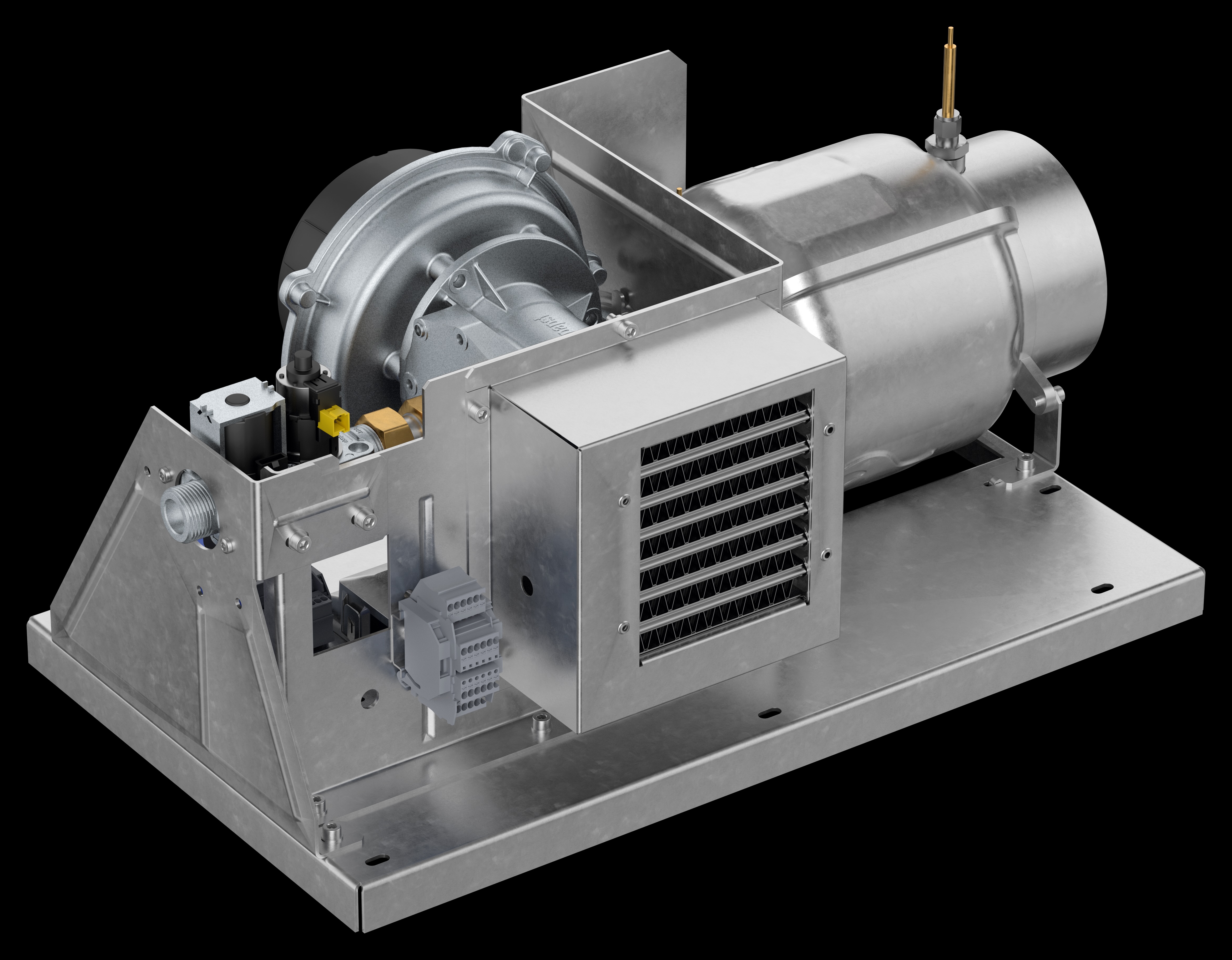
Hydrogen is mixed into an air stream and passed through a catalyst, where it reacts flamelessly with the oxygen in the air and releases heat. The hot air is generated where the process needs it — no flame, no boiler, no flue.
At the core of every system is a HYTING heat generator of 10 or 50 kW, modulating between 10 and 100% of its rated output, so the heat follows the process instead of cycling on and off. Units are combined in parallel, and output is built up in 10 and 50 kW steps — thirty 50 kW modules make around 1.5 MW. The technology stays the same; only the number of modules changes.
Hydrogen grade A to ISO 14687 is sufficient, supplied from cylinders, a pipeline or on-site electrolysis. The generator is approved under the Gas Appliances Regulation (GAR) and has completed a 2,500-hour endurance test in cyclic operation, equivalent to around ten years in service.
Next step
A 60-minute introductory meeting on your process, your temperature levels and your hydrogen situation. You get a first assessment, and we deliver turnkey from there.