





Oxygen Gas Analyzer MOD-1040
Oxygen plays an important role in any chemical- or biochemical-based industry. In many cases, the presence of certain levels of oxygen may affect chemical reactions, initiate undesired chemical side reactions, and cause deterioration of stored chemicals, pharmaceuticals or food compounds. In addition to that, oxygen may also induce fire and explosion-hazardous conditions. Various oxygen analysers can be found in the market, which are used in the chemical industries for online determination of the oxygen content in liquids or gases, and to prevent its impact on the process. These analysers are based on several technologies, which utilize different physical and chemical phenomena that are incorporated in the sensor. The resulting analysers include paramagnetic, zirconium, coulometric, TDL, and galvanic electrochemical analysers. Depending on their sensor technologies, each of these analysers has its own restrictions for their utilisation in an application. The restrictions include pressure and heat, cross-sensitivity with other compounds, humidity, and in many cases safety concerns, such as fire and explosion hazards, or sample conditions such as dusty or corrosive environments.
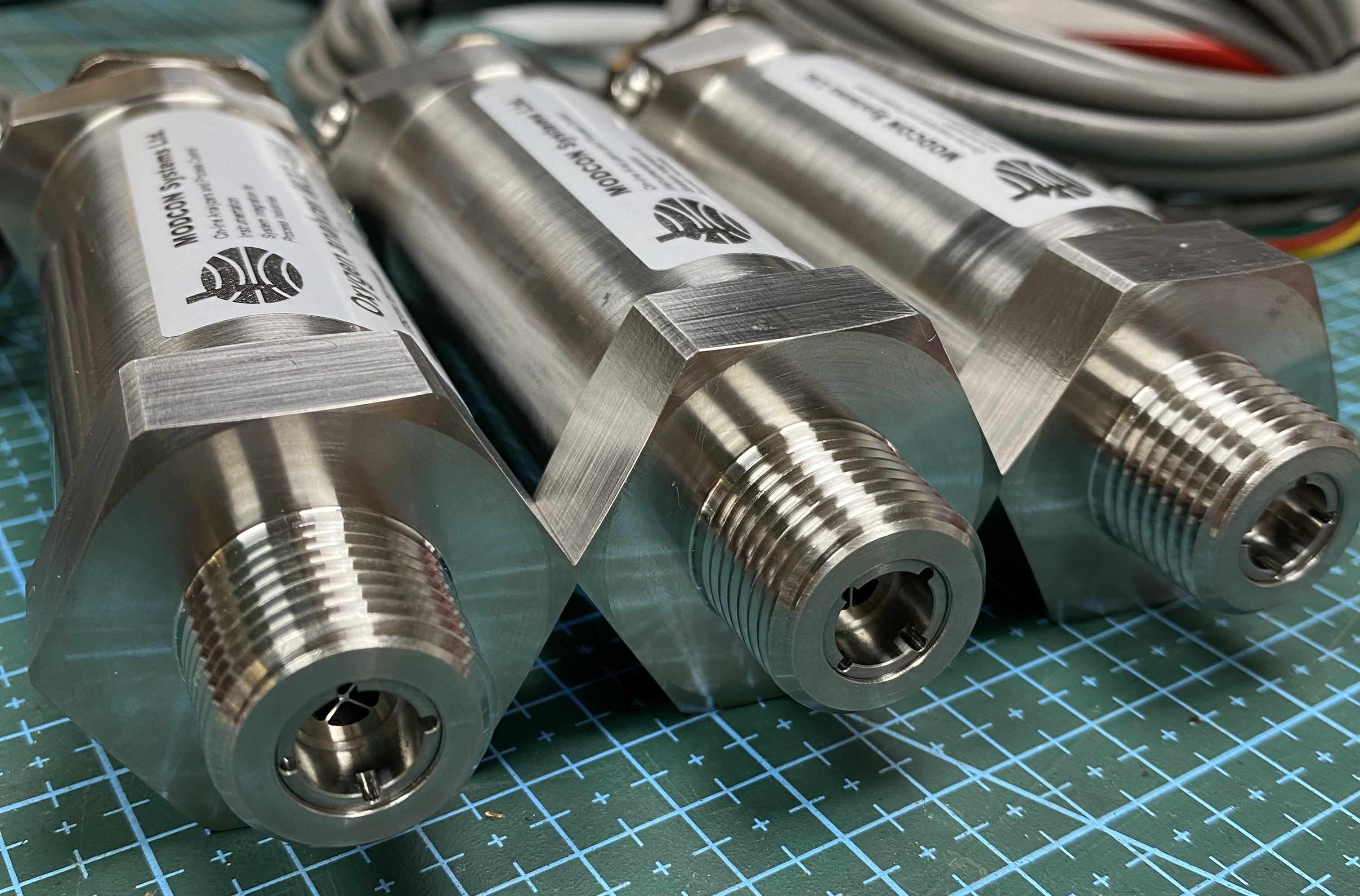
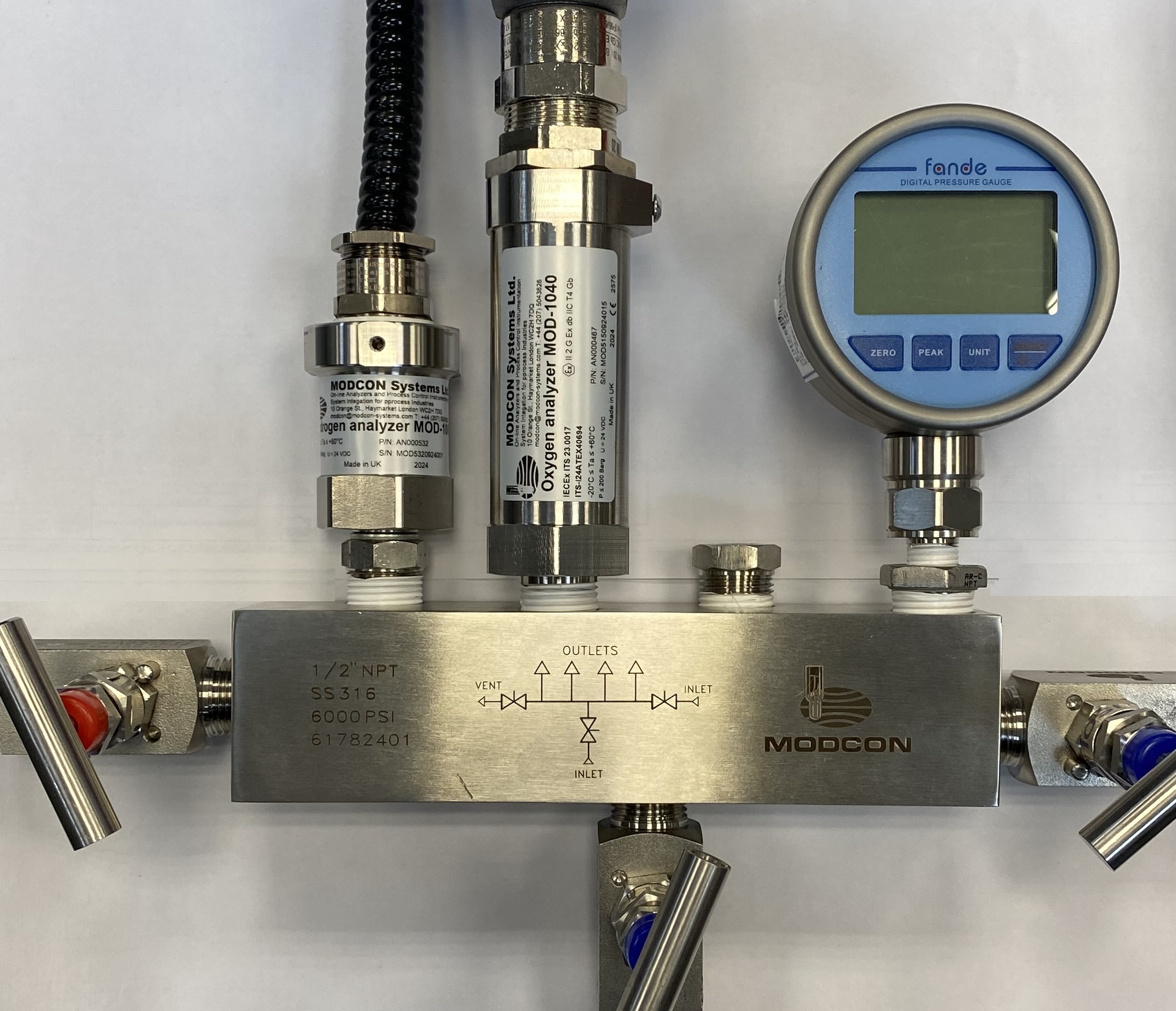
Modcon Systems developed its MOD-1040 process analyser to determine the oxygen content in a wide range of applications where accurate determination of the oxygen content is required.
The MOD-1040 oxygen analyser employs a novel chemiluminescence technology. A sample is illuminated with red light of a specific wavelength that passes through a tiny transparent polymeric A beam of red light causes photoexcitation of the luminescent coating. Upon relaxation, fluorescent light returns to the analyser, but at a different wavelength as the wavelength of the source light. However, oxygen quenches the formation of luminescence of the fluorescent light.
DANGER OF OXYGEN IN HYDROGEN
The presence of oxygen plays an important role in the safety of hydrogen-containing processes, Whereas the LEL (lower explosive level) of Hydrogen is generally considered to be 4% by volume (4% v/v). That means the mixture is too lean to burn if there is less than 4% Hydrogen present. But at 4%, we can burn or explode if there is an ignition source. So 4% v/v hydrogen is the same as 100% LEL of the explosive concentration. The upper explosion limit is at 75 % (v/v).
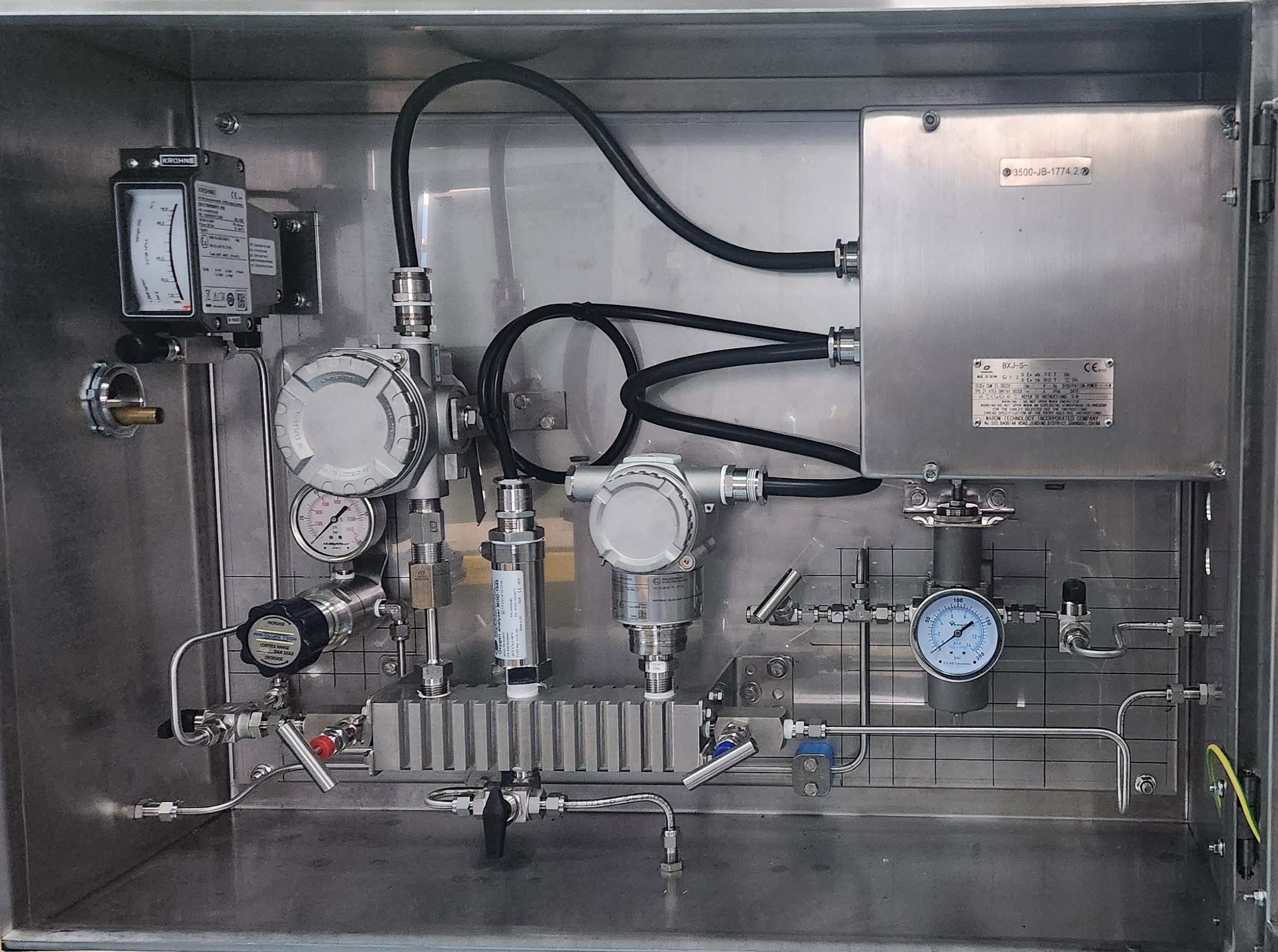
This means that from a safety point of view it is critical to monitor the oxygen content in a hydrogen process stream, and to prevent the occurrence of dangerous mixtures of oxygen and hydrogen. Although most hydrogen-using chemical processes are designed to prevent hazardous situations during transporting hydrogen in pipelines, and its use as a reagent in chemical reactions, any leak in the process may increase the oxygen content to a hazardous level. By means of the MOD-1040 oxygen analyser, any sudden increase of the oxygen content is immediately detected and allows immediate steps to be taken to refrain from any disaster to occur.
Most available oxygen analysers are not compatible for use in hydrogen-containing processes. Either their sensors are not explosion-proof, or the process conditions are such that temperature or pressure conditions, like very high pressures or very low pressures, prevent the use of traditional oxygen analysers. In addition to that, the majority of traditional oxygen analysers need sampling and sampling conditioning systems, which by themselves can be a source of oxygen leaking into the system.
The introduction of the MOD-1040 light-based analyser overcomes these obstacles of traditional oxygen sensor technologies.
Key features of the Oxygen Analyzer for high-pressure applications include:
• High-accuracy measurement of oxygen levels up to
100%
• Explosion-proof certified: ATEX/IECEX Zone 1
• Explosion-proof certified: Class 1 Div. 1 (pending)
• Safety Integrity certified: SIL SIL-2
• Response time (T90): <5 sec
• Ambient temperature: -20 to 60 degC (-4 to 140 degF)
• In-situ direct oxygen measurements
• Flexible installation with zero maintenance
• Built-in temperature and pressure compensation
(optional; requires transmitter and gauge pressure
transmitters)