


Fraunhofer ISE reports record in solar hydrogen production
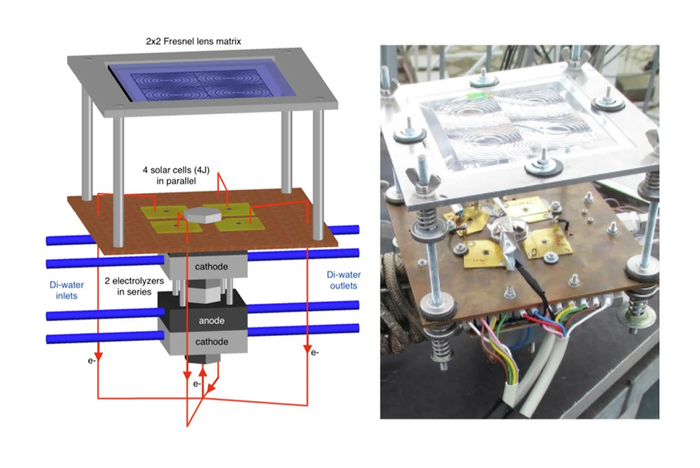
The module works by splitting water molecules using the high photovoltage generated by multi-cell modules. These modules are, in turn, electronically and thermally connected to electrolyzer cells.
CPV supplies electrolysis cells with solar power
The core component of the photovoltaic/electrolysis module is CPV: An array of Fresnel lenses focuses direct sunlight onto III-V solar cells with an open-circuit voltage of over 4 volts, explained Dr. Juan Francisco Martínez Sánchez, project manager for the new development at Fraunhofer ISE.
III-V solar cells are considered the world’s most efficient solar cells. Currently, they are used primarily in space, but could also be utilized in CPV modules on Earth for electricity generation. A Fresnel lens is a special type of optical lens whose structure results in less volume and mass than conventional lenses.
Dr. Tom Smolinka, head of the Membrane Electrolysis Department at Fraunhofer ISE, added that in the photovoltaic/electrolysis module, the solar cells are directly connected to the cathode and anode of two PEM (proton exchange membrane) electrolysis cells connected in series. This allows the electricity from the solar cells to be used directly for hydrogen production without any detours.
Demonstrator achieves 31.3 percent conversion efficiency
In field tests, a demonstrator of the photovoltaic/electrolysis module converted up to 31.3 percent of solar energy into chemical energy, based on the calorific value of hydrogen. The lens area was 64 square centimeters. The outdoor tests were conducted over 13 summer days in Freiburg on a dual-axis solar tracker.
Clearsun Energy aims to advance the technology
“The development is still in its early stages,” said Dr. Frank Dimroth, head of the III-V Photovoltaics and Concentrator Technology Department at Fraunhofer ISE. To further develop the concept, the team is now seeking investors for the planned spin-off, Clearsun Energy.
Clearsun Energy joined the AHEAD program in 2022. AHEAD is a Fraunhofer technology transfer program that guides and financially supports deep-tech founders from the initial business idea through the development of a business model to market entry. In 2025, the Werner Siemens Foundation invested 14 million euros in further cell and module development at Fraunhofer ISE.
Starting in 2028, Clearsun Energy aims to achieve an annual production capacity of more than 300 MW for CPV cells. By 2030, the company plans to scale up to over 1 GW annually for micro-CPV modules.
(Source: Fraunhofer Institute for Solar Energy Systems ISE, Clearsun Energy/2026)