





New Model Predicts Turbine Life Under Hydrogen
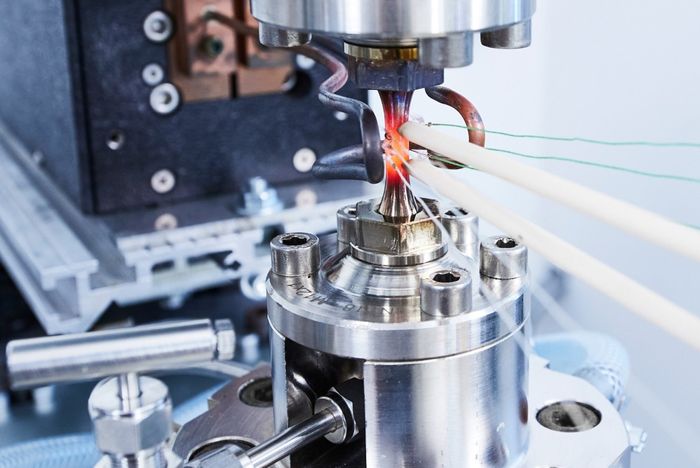
Hydrogen can speed up crack growth in turbine components by a factor of 100 or more. Researchers at Fraunhofer IWM have built a physics-based simulation model that captures this effect for the first time, letting manufacturers of gas turbines and aircraft engines cut costly test-rig trials.
How long will a turbine component actually survive under hydrogen exposure? Engineers have long struggled to answer that with confidence. Conventional fracture mechanics calculations tend to run overly conservative, because so many variables interact at once: hydrogen pressure, gas purity, temperature, material condition, and mechanical load. No single test captures all of them together, forcing manufacturers into extensive — and expensive — test campaigns.
The early crack-growth stage matters most. As cracks grow from roughly 20 micrometers to a technical crack length of about one millimeter — the so-called low-cycle fatigue (LCF) phase — they account for up to 90 percent of a component's total service life. Hydrogen accelerates crack growth during this phase by a factor of 100 or more. Since engineers previously had no physical basis for calculating that effect, components had to be designed with large safety margins.
The HELP Effect Explains the Damage Mechanism
Researchers at the Fraunhofer Institute for Mechanics of Materials IWM tackled the gap directly. Their new crack-based simulation model captures hydrogen's influence on the LCF phase using physical principles for the first time. It factors in hydrogen pressure, load frequency, and mechanical load range, building on elastic-plastic fracture mechanics.
At the core sits the HELP effect (Hydrogen Enhanced Localized Plasticity): hydrogen atoms migrate to the crack tip and occupy dislocations in the metal lattice. That raises local plasticity and speeds up crack growth. Above 400 degrees Celsius, the model also accounts for oxygen diffusion along grain boundaries as an additional damage mechanism.
Fewer Test-Rig Trials, More Design Confidence
"Hydrogen atoms mobilize dislocations in the metal lattice, accelerating crack growth as a result," says Fabien Ebling, project lead at Fraunhofer IWM. Rather than relying on empirical rules of thumb, the model explains the physical root cause of the damage.
The model delivers the greatest value early in development, before component geometry and operating concepts are finalized. Engineers can run parameter studies, define pressure limits, and assess how test frequency affects damage — all before building a first prototype. That cuts the need for expensive hydrogen test-rig trials and lets manufacturers set safety factors on a more realistic basis.
(Source: Fraunhofer IWM/2026)